

Scientist Badge

The Scientist badge features a test tube |
Requirements of the badge
The scientist badge requires six experiments or investigations to be done, three from the physical world, and three from the living world. The specifications for this badge are also available on the scouts.org.uk website
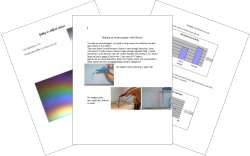
Two of our cubs, Marcus and Elio, independently attempted this badge at home and wrote up the results of their experiments so they could show Akela what they had each done. Some of these are available on this website as an example:
|
Physical world
- Make a simple switch. Show how it could be used to control a light bulb powered by a battery.
-
Show how electrical currents produce magnetic, chemical
and heating effects, and explain what happens.
See Marcus's electromagnet experiment here - Show that hot air rises.
-
Make an artificial rainbow by splitting up a beam of white
light.
See Marcus's artificial rainbow write-up here ofElio's here - Make a pin-hole camera and understand the principles of operation.
- Keep simple weather records over a month, e.g. rainfall, temperature, cloud cover, wind direction.
- Make a simple compass and show the effects of metallic and magnetic materials upon it.
- Make a simple periscope.
- Show how to recover dissolved substances from a water
solution.
Read Elio's salt water experiment in his report - Recognise three different constellations.
- Make a model to show how the Earth orbits the Sun
See Elio's finished model in his report
Living world
- Make some yoghurt and find out how living organisms are involved in the process.
- Grow cress (or a similar plant) and investigate what happens
when light and water are excluded from it.
Read Elio's experiment and his results on page two of his report - Use a net and jar to find out how many different creatures live in the water and mud at the edge of a pond.
- Set up a wormery or ant colony and record the activity over a few weeks.
- Grow a bean or pea. When the root and shoot are visible
investigate what happens when the seed is turned upside down and left
to continue growing.
See the results of Elio's experiment on page three of his report - Collect seeds from various plants and discover how these are protected and dispersed.
- Grow crystals or make crystal shapes from paper
See the red crystals Elio grew on page three of his report - Investigate what happens to their pulse rate before during
and after exercise.
See Marcus's pulse rate experiment results here
 |
last updated: Mon Oct 27 2014 | site info |